
AI usage policies that apply where work happens.
Configure local warning, redaction, and blocking actions for supported AI workflows, then pair recorded outcomes with workflow-specific verification.
Book a 20-minute callA normal workday
A teammate pastes a customer dispute into an AI chat to write a faster reply.
On a supported, verified integration, G.A.I.N. checks content on the device and applies the configured action before submission. Coverage and fallback behavior remain workflow-specific.
Policy response
Customer data rule
Intended verified-path outcome: matching values are replaced locally before the redacted request is sent.
How it works
A policy needs a real control behind it.
Set the rule once
Choose what to detect, which supported tools it applies to, the action, and any department scope.
Apply it at the moment of use
G.A.I.N. checks supported browser or agent workflows locally before making a policy decision. Verify the current path before relying on enforcement.
Keep evidence, not prompt content
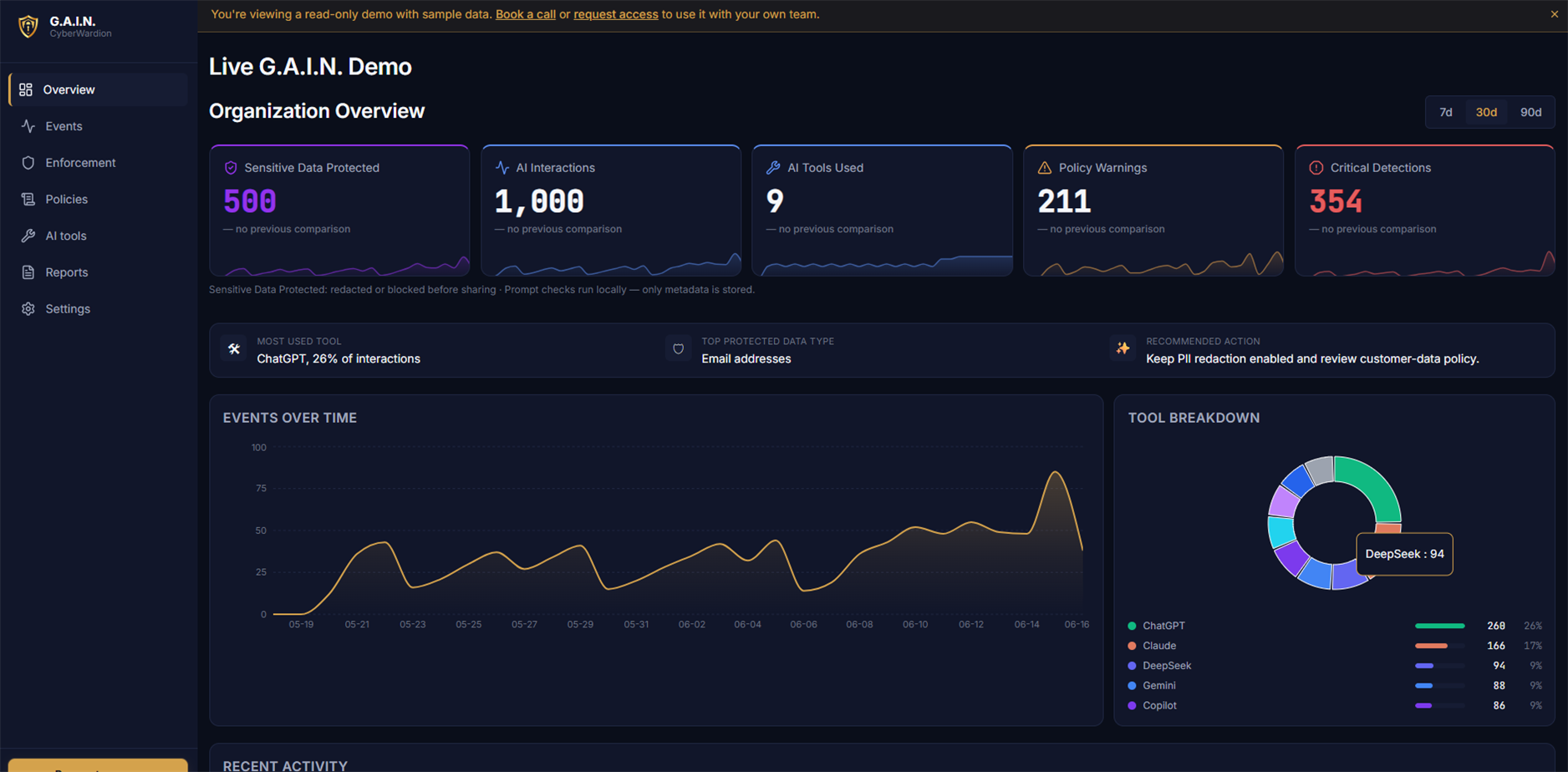
The dashboard records metadata about the tool label, category, reported action, and time. Pair the record with a workflow receipt before concluding enforcement ran end to end.
Policy actions
Choose the response that fits the risk.
Keep the person in control
On a supported path, show an inline warning when a policy needs deliberate review before submission.
Keep useful work moving
On a verified redaction path, replace matching values locally before the redacted request continues.
Stop the highest-risk data
On a verified block path, stop a configured category before submission when warning or redaction is not appropriate.
A control you can show a client or auditor.
G.A.I.N. checks supported content locally and sends event metadata—not prompt or file bodies—to the configured G.A.I.N. backend. If an allowed or redacted request is sent, the selected AI provider may still receive it.
- Tool
- ChatGPT
- Category
- Customer data
- Action
- Redact
- G.A.I.N. event record
- Prompt body excluded
Where this applies
- Browser integrations designed for ChatGPT, Claude, Gemini, Microsoft Copilot, and Perplexity; verify the current browser, version, and provider page.
- Configured local coding workflows where the G.A.I.N. Agent is installed.
- Department-scoped and tool-scoped policy rules.
What it does not claim to do
- It does not inspect every website or act as a general browser monitoring product.
- Prompt and file bodies are excluded from event records; organization-configured device or user identifiers may be shown to authorized administrators.
- It complements access control, secret management, and endpoint security. It does not replace them.
Questions
Before you put a policy into production.
Do we have to block AI tools to use G.A.I.N.?
No. Teams choose the action for each policy. Many begin with log-only or warning rules, then use local redaction for routine sensitive data and blocking for the highest-risk categories.
What does a manager see after a policy runs?
The dashboard receives metadata such as the tool label, detection category, reported action, severity, department, and timestamp. Prompt and file bodies are excluded from event records.
Can different teams have different rules?
Yes. Policies can be scoped by supported tool and department so a finance, support, or engineering team can have rules appropriate to its work.
See the policy on your real workflow.
In 20 minutes, we can map the AI tools your team uses and show the policy actions that fit them.
Book a 20-minute call